

• AI can challenge our certainties by seeking out contradictions and complementary sources, but its analyses depend heavily on how we formulate our hypotheses.
• The more knowledge management is automated, the more essential human curation becomes: what goes into the system determines what it outputs—and the level of trust we can place in it.
Information monitoring is at the heart of my job: it allows me to detect weak signals and understand the underlying trends in the technology ecosystem. However, I had reached a limit: spending more than two hours a day reading, analyzing, cross-checking, and organizing information. One question lingered: how can I maintain consistent knowledge over time, as information accumulates and some of it becomes obsolete?
A personal wiki linked to an LLM
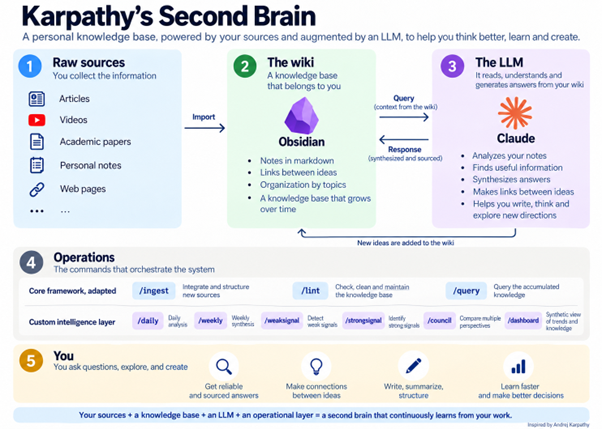
I drew on the “LLM Wiki” pattern proposed by Andrej Karpathy, co-founder of OpenAI and former head of AI at Tesla. The idea: rather than forcing an LLM to rediscover its documentation with every query, entrust it with maintaining a personal wiki that grows with each new source added.
In practice, I use Obsidian as the interface, Git to track history, and Claude Code to perform analysis and generate content. Everything stays locally, in Markdown. When I add a source captured from my browser, the system extracts concepts and entities from it, links them to existing knowledge, and then verifies the consistency of the whole.
It took just half a day to set up, followed by an iterative process to refine and develop the operations of my “second brain,” and my daily research time has gone from two hours to thirty minutes. The key: first formalizing my own way of working—as a human—and then letting Claude Code derive the details and implement the processes that support me in my daily monitoring.
One question remains open: long-term sustainability. Ingesting my daily sources, which took a minute at first, now takes about ten.
An AI that challenges what I think I know
This regular verification is the feature that benefits me the most. A checking process, called “lint,” regularly reviews the wiki for contradictions, statements that have become obsolete, and important ideas based on a single source… The system then suggests that I cross-check them against other sources. The AI becomes a sparring partner that forces me to question the soundness of what I think I know.
I’ve gradually added daily and weekly summaries, the detection of weak and strong signals, and even a “consultation”: a panel of personas who examine the same question from different angles. I’d initially envisioned personas based on major tech executives, but eventually abandoned the idea—too much caricature, too much groupthink. Another, unexpected lesson: depending on how I phrase a thesis or antithesis, I strongly influence what the system finds. An AI can challenge my reasoning, but it just as easily inherits my biases.
What I Don’t Want to Delegate to the Machine
The more I delegate the management of my knowledge to AI, the more I realize the importance of what I keep for myself: the choice of my sources and my own judgment.
I’m the one who decides whether an article, a study, or an analysis deserves a place in my “second brain.” I could have automated this collection process, but I need to know the basis for what the system returns to me. I leave the memory, the connections, and much of the maintenance to the machine. I remain the one who chooses what deserves attention and who ultimately decides what to make of it.
This text has been translated by an artificial intelligence.