

• A decoder that recalibrates too quickly not only degrades performance but also hinders the user’s own learning.
• François Bourquin, an artificial intelligence specialist at Orange, places these findings within the broader debate on human supervision of learning systems.
Myoelectric prostheses, brain-machine interfaces, gesture-control wristbands: in these medical applications, a sensor collects a biological signal, which an algorithm translates into a command. This decoder determines whether a particular muscle contraction means “right” or “left.” Long fixed after an initial calibration, it now recalibrates in real time during use to adapt to each person’s signal. For innovation in the medical field, this is a boon. However, the user learns as well: they see the cursor move, make corrections, and discover which contractions produce which movements. Thus, two learners adjust to one another within the same loop, in real time. We’re still figuring out this coupling by trial and error, due to a lack of tools to predict the outcome.
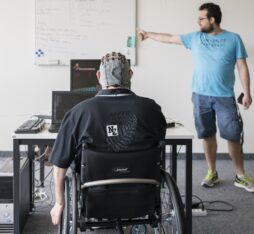
Researchers at the University of Washington have set out to address this. Their method draws on control theory to model user behavior, and on game theory, which treats both as players each pursuing their own objective: the human aims to hit the target with as little effort as possible, while the algorithm minimizes error without over-adjusting its settings. Their test setup involved fourteen participants who had to hit a moving target on a screen using a cursor controlled not by a mouse but by the muscles of the forearm, detected by 64 electrodes. The decoder recalibrates every twenty seconds, and the researchers adjust its settings one by one to observe the effect on the human participant.
Human Rhythm as a Design Constraint
The first setting tested was the recalibration speed. In the fast version, performance deteriorated, which is hardly surprising. The unexpected result lay elsewhere: the user’s muscular strategy changed less than in the slow version. Human learning wasn’t interrupted due to a lack of effort, but because the target was moving faster than the user could keep up with it. This finding comes as no surprise to François Bourquin, who has forty years of experience in artificial intelligence: “There is a biological rhythm and there is a cognitive rhythm: humans simply cannot go any faster.” He observes this phenomenon daily among developers who have AI write their code: “The machine generates code so quickly that they barely have time to read it.” Their work, which used to be creative, is becoming mechanized, “and that’s when they burn out. This pace is simply not suited to humans.” Speed also does not guarantee accuracy: “Just because AI works faster doesn’t mean it doesn’t make mistakes.” His conclusion can be summed up in one line: “It’s the machine that waits, period.” Automation is not comprehensive: even if, in the context of no-code, the specifications tend to come directly from the business units, oversight of the deliverables remains necessary.
What Effective Oversight Achieves
The expert drew a practical lesson from a seminar attended by several hundred people divided into dozens of working groups, where note-taking and summarization had been entirely delegated to a generative tool. The result was circulated throughout the room for validation: “And you in the room, is this really what your working group said?” Hands went up, and omissions were pointed out. Nothing unusual about that: “Ask an AI for a summary, and it’ll give you three different ones in ten minutes—and none of them will include the same key points.” This led to a proposed method: “We’d almost need beta versions where humans first co-learn with the machine before rolling out that co-learning to a larger audience—but only after it’s been refined.”
A Need for Stricter AI Governance
“You don’t get the same result depending on which ‘teacher’ you have,” observes François Bourquin. Yet a language model “has absolutely no understanding of what it is absorbing”: it makes statistical comparisons; it does not make judgments. Co-learning without taking a step back therefore amounts to delegating judgment to the model. Hence his conclusion: “The real issue, beyond taking a step back, is the kind of governance we want for AI.” Yet this governance, he argues, is being sidelined by the imperative to bring products to market: “We need safeguards, which aren’t currently being put in place.” For him, “the humanization of co-learning is paramount.” And, ultimately: “It’s up to humans to decide how far this should go.” The work conducted in Washington reaches the same conclusion through an engineering lens: the speed of recalibration is not a technical detail; it’s a human decision made upstream by those who design the system. And performance alone does not determine whether it is good. “Without human supervision, there is no salvation.”
 François Bourquin