

More than 300 billion emails are exchanged worldwide every day. Are you among those who regularly delete them? How many videos have you watched on social media this week? And most importantly, could you quantify the carbon footprint of these digital activities?
Unlike our household electricity consumption, the environmental impact of our digital habits remains largely invisible, and as a user, quantifying one’s digital-relatedCO₂ emissions is often a real headache. You may have heard that you should delete your emails to avoid unnecessary data storage. But did you know that video streaming accounts for 80% of global data traffic, generating more than 300 million metric tons of CO₂in a single year?
As a major player in the digital sector, Orange is mindful of this issue. Supporting customers in their use of digital technologies and reducing the carbon footprint associated with that use is one of the key priorities of its Corporate Social Responsibility efforts. Orange has therefore set an ambitious goal in this area: to achieve net-zero carbon emissions by 2040. This commitment is broken down into three scopes, a classification system that categorizes the various sources of emissions. Scope 1 corresponds to emissions directly produced by the company’s operations resulting from the use of fossil fuels. Scope 2 includes indirect emissions linked to the organization’s purchased energy consumption.
Finally, Scope 3 corresponds to indirect emissions resulting from the company’s activities and encompasses, for example, customers’ use of Orange products and services. This is one of the scopes where it is particularly important to take action.
To achieve the goal of net-zero carbon, Orange’s research teams are exploring, in particular, how to encourage users to adopt more responsible digital practices through human-machine interfaces in interactive systems.
Through this experiment, Orange Research aims to provide recommendations to service designers by bridging the gap between behavioral science theories and the principles of human-computer interaction.
Gentle incentives to help us change our habits
Some habits can be hard to break. How many of us have tried to start exercising or quit smoking once the holiday season is over?
To motivate us and raise awareness, systems exist: systems designed to support behavioral change. In economics, these are called “nudges.” They’re little nicks to help us change our behaviors. For example, those messages or illustrations you come across on the subway encouraging you to take the stairs instead of the escalator. Or the number of likes on your post about your latest workout.
Creating this kind of system for digital moderation—a major societal issue—requires studying users, their habits, attitudes, and motivations, and understanding the barriers to behavioral change. Psychological theories provide us with insights to better understand these factors. In particular, they tell us that when we commit to something as a group, we are more motivated to complete a task and achieve a goal. Can we apply this to digital moderation behaviors?
And how can we incorporate support for digital detox into an attractive interface tailored to users’ needs? The challenge lies in translating this knowledge into concrete interactive systems.
This is the central challenge of the research project currently being conducted by Orange.
A family-based experiment that bridges the gap between behavioral science and interaction design
Prior to the launch of the pilot program, an initial user study provided insights into individual motivations for digital moderation and highlighted certain gaps in understanding the environmental impact of digital usage. This study brought together 30 participants to discuss responsible digital use during a “digital café,” an online forum hosted by Orange dedicated to user research. This initial study showed that digital users can define what responsible digital use is, but that they have difficulty clearly identifying both the uses that have an environmental impact and the actions they can take to reduce their carbon footprint. Regarding their motivations, we observed that, overall, digital users want to reduce the impact of their consumption of digital resources, but they need guidance in this process. Participants thus expressed a desire for support that could take the form of a collective effort, as a family, centered on goals and/or challenges that spark everyone’s interest and make changing habits fun. This study provided recommendations for future research and helped shape the design of the pilot program to be tested.
Our research team is therefore currently conducting an experiment.
The researchers have designed an innovative system that families are currently testing. This system combines a mobile app with an interactive box installed in participants’ homes. The goal is twofold: to help households become aware of their digital-relatedCO₂ emissions and to assist them in meeting weekly reduction targets. Thanks to this system, families can view the impact of their digital habits in real time and set collective and individual challenges to reduce their carbon footprint.
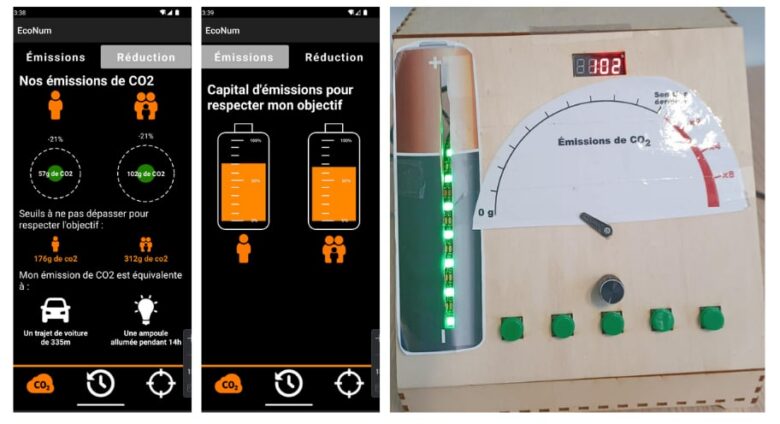
The implementation of a family-oriented approach has already helped create an atmosphere of collective learning and fostered a playful awareness among household members regarding issues of digital sufficiency. The physical manifestation of this support—through the box, LEDs, meters, and displays—also allows it to become fully integrated into the household’s daily life. As a result, energy conservation becomes a topic of discussion within the family and even a playful challenge among its members.
Through this experiment, Orange Research aims to provide recommendations to service designers by bridging the gap between behavioral science theories and the principles of human-computer interaction.
The goal is to develop interfaces that make digital moderation accessible, understandable, and even desirable.
The path to a more sustainable digital future is built together
The transition to a more responsible digital future cannot rely solely on individual goodwill. It requires tailored tools that help everyone become aware of their impact and gradually change their habits. Through this research, Orange demonstrates that digital moderation can become a collective, fun approach that is naturally integrated into our daily lives. This research is part of Orange’s commitment to guiding its customers toward a more thoughtful and responsible use of the digital resources at their disposal. The path to digital moderation is not a solitary one; it is a collective effort that we aim to support effectively, one step at a time… and it begins with each of us becoming aware of our own impact.
This text has been translated by an artificial intelligence.
 Tom Jullien
Laurence Dhaleine
Anthony Foulonneau
Tom Jullien
Laurence Dhaleine
Anthony Foulonneau