

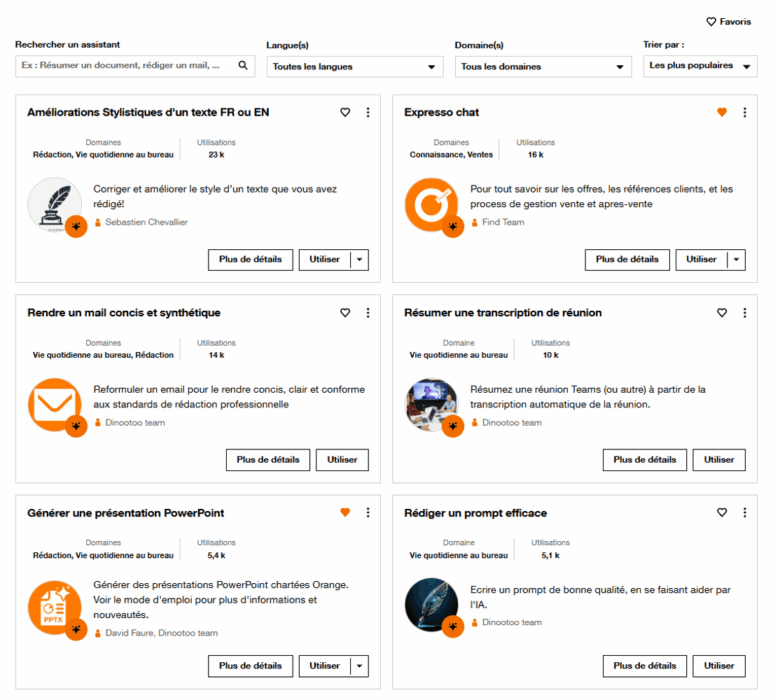
• Some 70% of staff have already used in-house AI assistants, notably popular solutions that expedite daily tasks such as email management, the creation of PowerPoint presentations and text optimisation.
• To ensure that they meet operational needs, development of the assistants begins with meticulous analyses of existing processes and also features elaborate multi-stage prompt engineering.
At Orange, the drive to integrate generative AI is built on close collaboration between business stakeholders and technical experts to develop practical solutions for specific operational needs. In its Dinootoo library, Orange already offers more than 150 dedicated genAI-powered assistants, which are informed by a simple principle: generative AI only creates value if it addresses identified business needs. “We have the prompting and generative AI expertise, but the business stakeholders have a better understanding of their needs and high added-value use cases. So we are working together to transform these needs into AI assistants, explains Orange AI & Data Product Manager Mahdi El Bahi.
The most popular assistants are those that expedite repetitive and time-consuming tasks
The library, which is organized by business areas and by languages, offers an extensive range of assistants for targeted purposes such as identifying KPIs for project managers or analysing contracts for in-house lawyers. All the assistants are documented: “They all have a title, a description of the LLM they utilize and a detailed user manual.” The goal is to ensure that they are presented in a way that makes them accessible and immediately useful. “We cover a wide range of business fields: purchasing, communications, architecture and legal functions etc.”
Massive adoption for a wide range of uses
Some 90,000 employees — a remarkable 70% of the group’s workforce — have made use of the new assistants. Among the most popular are models designed to take charge of “everyday office tasks” (+ 100,000 executions) like email management, the generation of PowerPoint presentations, the preparation of documents and the “rewriting of text”. Adoption is being led by sales teams interacting with Expresso chat to obtain information on offers and customer references (accounts), as well as sales and after-sales management processes, while legal, communications, project management, tech, HR and marketing functions are also in demand. “The most popular assistants are those that expedite repetitive and time-consuming tasks such as the assistant for drafting job offers that we developed for HR.” points out Mahdi El Bahi.
A methodology that avoids pitfalls
There is a proven methodology underpinning the success of the assistants: “We start with the identification of a specific operational need and then we analyse the current process: its duration and its strengths and weaknesses etc.” The goal is to evaluate potential time savings as well as the carbon footprint and the business impact of each project. The development of a model for a particular use case requires an average of six to eight weeks, a period that notably includes time for workshops with the relevant business teams and testing phases. “Generative AI is not suitable for every use case,” points out Mahdi El Bahi.
Prompt engineering plays a key role in the efficient functioning of the assistants. “We create precise instructions to ensure that models are fully optimised for specific needs. For example, for the HR job offer assistant, we developed a very elaborate 14-stage prompt that includes detailed context on Orange and its employee value proposition.” Out of the box, models don’t know anything about the specific characteristics of Orange: “We have to provide them with all the necessary information described in a language that is suitable for communication with models, which differs from what we would use with a person.” It is this precision in the formulation of prompts which guarantees that results are aligned with business expectations.
“Our approach stands in contrast to many AI initiatives which fail because they are insufficiently grounded in operational realities. Generative AI can transform the daily lives of employees, provided it is deployed methodically and in response to concrete needs.”