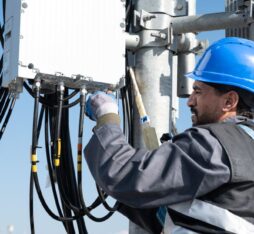
The telecoms sector faces mounting threats from geopolitical instability, cyberattacks, climate risks, and technical failures, which are increasingly impacting network infrastructures. As disruption grows more frequent, resilience has become a critical priority.
Modern society now depends almost entirely on digital systems, and any failure or crisis can have an immediate and widespread impact. At a keynote at Orange OpenTech, Michael Trabbia, Executive Vice President of Orange Wholesale, cites recent examples, including the recent energy blackout in Spain and an IT failure in the US that grounded flights worldwide.
Building a resilient telecommunications infrastructure to handle geopolitical, cyber attacks and environmental challenges.
Daily life is built on digital services
Today, 99% of the global B2B arm of the Orange Telecom Group’s operations pass through submarine cables and digital networks. “This has become a vital infrastructure for economies, citizens and government, with everything depending on digital now,” he says.
This dependence exposes us to new and growing risks. Alongside traditional technology failures, geopolitical and cyber risks are occurring more regularly. “These conflicts are not always armed,” he points out, citing the tensions between the US and China, which raise concerns that key technologies like satellite networks, such as Starlink, could be restricted or withdrawn. Cyberattacks are increasingly targeting operators. “While these risks existed in the past, with partnerships we are multiplying the risks,” he explains.
Jérôme Hénique, Executive Vice President and CEO of Orange France, also notes the climate risk associated with dealing with increasingly extreme weather outcomes. In the Chido cyclone, for example, Orange’s fixed and mobile networks in the archipelago were severely impacted. What was important, he said, was to be “resilient and responsive because we will have more of those crises”. Orange was able to restore large parts of the mobile network, covering 80% of the population, in less than 10 days.
“We have to anticipate and measure the risk and what our customers say, and I think we need to take this into account. Services are vital,” adds Hénique. “To inform customers with transparency and restore services quickly is a criterion when selecting operators”.
Orange has learned that restoring water, electricity, and the internet in under two hours is imperative for businesses, where trust is built. “Even if we can’t guarantee it for everyone, we have to guarantee it for businesses,” says Hénique, “So we are industrializing the crisis management system, and learning how to act quickly, capitalizing and learning lessons from the previous crisis”.
The importance of a climate adaptation strategy
Huu-An Pham, Vice President, Territorial Adaptation at AXA, underscores the importance of adapting to climate change to support resilience efforts. “The regulatory objective and extra financial reporting are domain drives to oblige companies to disclose any initiative they would take to be more resilient,” he explains. “It is a matter of continuing business, strategic and operational daily life,” he says.
Pham points out that customers depend on providers for enduring business continuity, but this is not easy, as there is “a lot of interdependence”.
Hénique agrees. “We do a lot, and we don’t do it alone,” he said. “We need energy first of all to run the infrastructures, so working with entities and different partners, we need them, and they need us in times of crisis,” he says.
Orange is taking bold steps to ensure its resilience. It is investing €50 million over the next five years in redundancy and backup systems for networks. It is also investing in rightsizing, robust design and strong repair capabilities to ensure systems can recover quickly and continue operating under stress. “When you have a climate crisis, you have to see if the network is still operational and, if not, if it can be repaired. So, investment in the first response is all about continuation,” explains Hénique.
AXA Climate is helping with vulnerability assessments and, at a strategic level, identifying regions that are vulnerable to weather-related issues, such as flooding. This helps Orange develop response plans to ensure service continuity. “We need to demonstrate that we do whatever is needed to protect ourselves,” adds Hénique.
“We have to move from repair to anticipating, and the new crisis rationale is to anticipate more than ever,” adds Pham.
Orange infrastructure investment is ongoing
Orange is acutely aware that managing internet backbones carries significant responsibility. If systems fail, the impact is not just local; the entire network can be disrupted. The infrastructure must meet availability targets of 99% or higher, which require strict operational standards, explains Trabbia.
There are also significant technical hazards to manage, particularly submarine cables, which can be cut or damaged by natural events or human activity, for example. Route diversity and meshing are crucial so that if one cable collapses, traffic can be rerouted through alternative paths. Thus, backup alone is not enough. Orange also needs to provide sufficient capacity and fixes. Without sustained investment in prevention, redundancy and repair readiness, network reliability cannot be guaranteed.
Cyber risks with a new dimension
Malicious attacks are also on the rise, including malware injections, which add a new dimension to the challenges faced by the telecoms sector. Threat actors are increasingly exploiting network complexity and legacy infrastructures to disrupt services, compromise data and erode customer trust.
To address this, Orange is reevaluating its business model and adopting open-source technology. This, Trabbia says, will make its strategy “standalone and autonomous”. The new operational model is based on cloud technology to deliver faster services and innovate new solutions. If I want a new network today, it will take a long time, but if it is virtualized based on the cloud, we can rebuild the function in a few hours. This is a significant change to meet new challenges,” he explains.
Resilience cannot be achieved in isolation
While national-level planning is paramount, crisis preparedness and response also demand a global approach, supported by a worldwide presence, concludes Hénique. “You can’t be resilient on your own,” he says, maintaining that this is something they are continuously working on.
Looking ahead, the primary challenge is to embed transformation “into our DNA – into everything we do”, adds Trabbia, providing its customers with the confidence that they are accessing services they can rely on, that are being continually adapted for changing environments. Innovation at this scale cannot be done alone. “To move faster and innovate, we must collaborate,” he concludes. This means embracing open-source solutions and working closely with its partner ecosystem to collectively transform and provide long-term resilience.