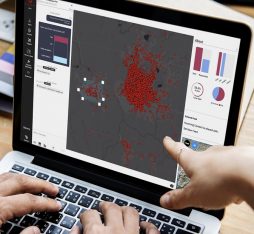
• The Fiber Detection project, conducted in partnership with VIAVI and Lightsonic, utilizes light backscattering and AI to accurately locate water leaks near fiber networks.
• Orange Fixed Access Networks Team Manager Philippe Chanclou explains how the new technology, showcased at the Mobile World Congress 2026, will unlock value in existing fiber-optic networks by offering new services for utility companies.
What is fiber sensing and what is it designed to do?
Fiber sensing is a technology that enables existing fiber-optic cables to function as smart sensors with the ability to detect vibrations in the surrounding environment. It can be used to locate leaks in pipe networks, monitor vehicle movements, and more. The goal of the Fiber Detection project is to unlock value in Orange Group’s infrastructure so it can be used to gather real-time data on events such as water leaks, earthquakes, and landslides. Orange Innovation, Orange France, and Orange Business are collaborating on a pilot project with several partners, notably VIAVI, a producer of signal analysis hardware, and Lightsonic, the developer of specialized AI that analyzes acoustic vibrations to detect water leaks.

Physical vibrations along the fiber path cause tiny changes in the fiber’s behavior, which affect the returned light in a measurable way…
How optic fiber cables reveal information about underground activity
This technology can be used with various sensing techniques, notably distributed acoustic sensing (DAS), which is the solution we are testing. It uses an interrogator unit developed by VIAVI that sends light pulses from one end of the fiber. These pulses are subject to backscattering, which returns a small portion of the light back to the emitting hardware. Physical vibrations along the fiber—caused by water leaks, vehicles, or people digging or walking nearby—result in tiny changes to the fiber’s behavior that influence this returned light in a measurable way. In other words, these micro-changes alter the optical signature of the backscatter in a precise manner that can be interpreted to produce highly accurate data.
How accurate is this technology and what are its potential uses?
Currently, the system can detect significant events within ten meters of the cable. Along the length of the cable, the location of an event can be pinpointed within one meter.
While we are currently focusing on water leak detection, this technology clearly has potential for other infrastructure-related applications near our access network. For example, it could be used by Orange to detect when street cabinet doors are opened or when branches fall on overhead lines. It can also be applied to analyze other vibrations, such as seismic activity and ground movement near critical storage areas, or to detect other types of leaks (gas, hot water, etc.).
Can you tell us about Lightsonic and its role in the project?
Lightsonic is a startup that has brought advanced expertise to the project through the development of AI algorithms needed to process fiber-optic data. These algorithms identify the unique acoustic signatures of different vibrations and use specially trained datasets to classify various types of events. They not only enhance raw data to ensure vibrational events are detected but also precisely locate and clearly identify them.
Why not use standard IoT sensors for this purpose?
Deploying fiber-optic detection offers significant logistical advantages. To perform the same task, standard IoT sensors would need to be installed every 100 meters, all of which would require batteries and regular maintenance. Fiber sensing solutions leverage existing infrastructure, eliminating the need to install additional equipment in pipe networks: everything is managed through a single connection point at the exchange, removing the need for active devices along the monitored route.