

Most observers estimate [ref. 01] that growth in usage, and associated sales of AI will follow an exponential curve, at least by 2030. This growth is underpinned by a particularly rapid AI adoption rate compared with that observed for other equally recent technologies where generative AI is driving this growth in AI usage [ref. 02].
This growth requires the corresponding material equipment in the form of servers providing the necessary memory, power and computing speed [ref. 03], which on one hand requires manufacturing that involves having natural resources (water, metals, etc.), and on the other hand operation, which assumes having the necessary electricity available.
The economic activities most likely to sustain themselves over time will be those that will have secured their electricity supplies.
Electricity required for AI Operation
Assessment for 2030
The growth in electricity required to operate the corresponding data centers will follow a more moderate curve than that of AI usage, thanks to energy and architecture gains [ref. 04]. However, these gains will not offset the growth in electricity needed to keep pace with demand.
The United States [ref. 05] has estimated a projection of data center consumption between 2024 and 2028, according to two scenarios (high and low), which includes on the one hand the growth in storage and computing power, and on the other hand these energy gains:
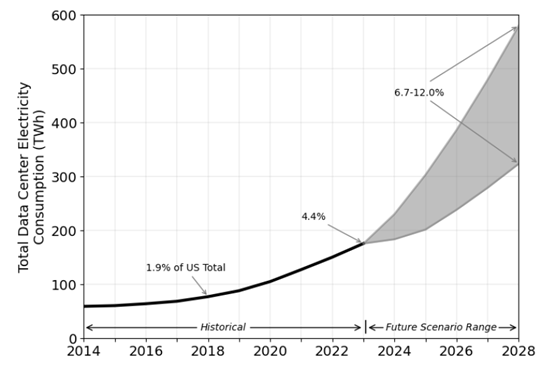
Source: 2024 United States Data Center Energy Usage Report, Berkeley Lab dec. 2024
Between 2010 and 2022, global electricity production grew by 50%. Between 2022 and 2040, it should grow by 100%, i.e. double and then increase by a further 25% between 2040 and 2050 [ref. 06], corresponding to linear growth from 2010 to 2050.
An admittedly simple model (approximation of the growth in energy requirements by an exponential curve) based on the data for 2024 and 2028 mentioned above for the USA, scaled up to the global level (the USA consumed 17.3% of the world’s electricity in 2023 [ref. 07]), of electricity consumption by data centers, using an average scenario built as the average of the two scenarios (LC and HC), leads to:

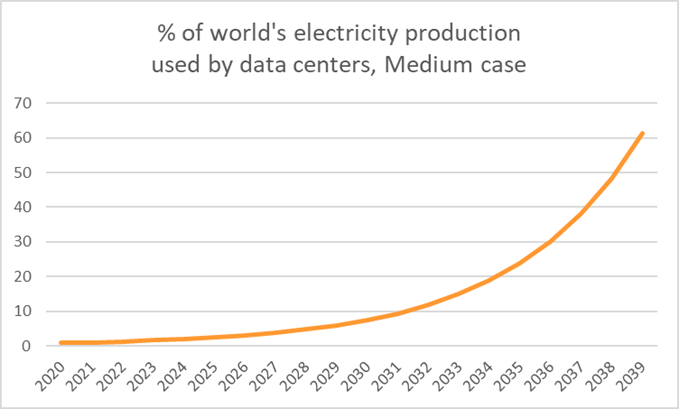
This extrapolation assumes that the share of electricity consumption in the United States relative to the rest of the world remains stable over the period, and that energy efficiency gains progress at an equivalent rate both within and outside the United States.
AI is not specifically taken into account in this assessment; however, it has been noted that the preponderant (exponential) part of this growth is linked to the use of generative AI [ref. 08]:
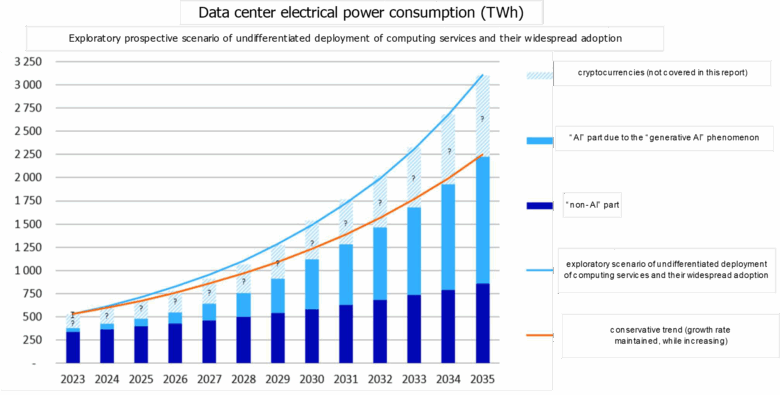
Source : Shift Project, oct. 2025
According to this estimative modeling, by 2030 7.5% of the world’s electricity production would be consumed by data centers.
Assessment beyond 2030
Using the data for projections beyond 2030 is risky, due to the scarcity of data and the high degree of uncertainty surrounding the evolution of other resources likely to support growth (metals in particular), as well as the growth in computing requirements linked to AI.
Unsurprisingly, however, it would reveal a divergence between (linear) growth in electricity production and (exponential) growth in data center consumption.
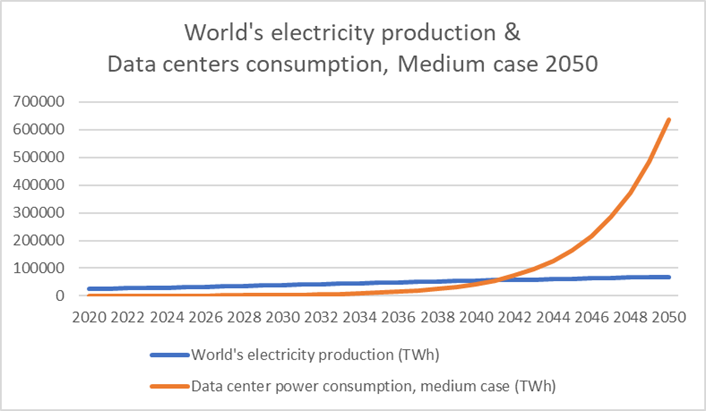
In particular, all the electricity generated in the world would be consumed for data center needs as early as 2041.
Analysis
Electricity usage conflicts
Electricity as a limiting factor for AI growth
AI growth, due to the surplus electricity it requires, will face its energy needs as a limiting factor for this growth.
As a result, it will intensify conflicts over the use of the electricity produced, which, unless a technological breakthrough appears (like controlled nuclear fusion in particular, under research since the 1960s), will very likely not be able to support to support this development.
This will raise the question of allocating electrical energy resources and the conditions of their availability among different economic actors.
Stakeholder positioning and search for new electricity production sources
The conditions for maintaining economic activity will then be, in addition to mastering one’s own production processes, access to electrical energy.
This analysis explains why some major electricity consumers are already seeking to secure their electricity supplies, particularly by:
- privatizing production centers for their benefit (e.g. sections of conventional nuclear power plants [ref. 09]);
- deploying their own means of production (solarization) [ref. 10];
- investing in or forming partnerships with innovative power generation facilities such as nuclear Small Modular Reactors (SMRs), which are modular and therefore well-suited to follow the growth of a data center [ref. 11].
From this observation, it also follows that the economic activities most likely to sustain themselves over time are those that will have secured their electricity supplies, either through direct control of their own electricity production means, or through certain financial capacity to access electricity financial markets.
Focus on France
Between 2035 and 2045, approximately half of France’s nuclear electricity production capacity will no longer be available. Indeed most nuclear power plants, built in nearby years during the Messmer Plan, are located on waterways under water stress and therefore cannot be maintained beyond 50 years for the most part [ref. 12].
Sources :
01 – Globaldata, Generative AI market report, 2024
02 – Mckinsey Global Survey on AI, 1,363 participants at all levels of the organization, Feb 22-Mar 5, 2024
03 – WSTS World Semiconductors Trade Statistics (11-2023), Gartner, IBS and Tech Insights forecast (01-2024)
04 – IEA, Efficiency improvement of AI related computer chips, 2008-2023
05 – Berkeley Lab, 2024 United States Data Center Energy Usage Report, p.31
https://doi.org/10.71468/P1WC7Q
06 – Planète-énergies, 2023 https://www.planete-energies.com/fr/media/article/production-delectricite-ses-emissions-co2
07 – IEA https://www.iea.org/reports/world-energy-outlook-2024/executive-summary?language=fr
08 – Shift Project, oct. 2025 https://theshiftproject.org/publications/intelligence-artificielle-centres-de-donnees-rapport-final/
10 – https://www.sciencesetavenir.fr/high-tech/transports/la-sncf-veut-alimenter-ses-trains-avec-l-energie-solaire_183875
11 – https://www.datacenterdynamics.com/en/analysis/nuclear-power-smr-us/
12 – RTE France fig. 4.2, p.7 https://assets.rte-france.com/prod/public/2022-06/FE2050%20_Rapport%20complet_4.pdf