

The technological building blocks required for field work are already in place: AI, digital twins and XR (eXtended Reality). However, a purely technology-push approach would not be best. So how can we implement these technologies in a relevant and coherent way to offer field engineers better interactions—ones enriched by technology—so that they can take more effective action in the field and/or from control rooms?
To achieve this, nothing beats the user-centred approach, which allows us to gain a deeper understanding of the work of field engineers, understand what happens during field interventions and envision innovative and relevant use cases, developed in collaboration with engineers and designed to meet their specific needs.
When a user-centred approach is incorporated into research projects. Envisioning innovative and relevant use cases with and for field engineers.
| Methodology
A user-centred approach was adopted, integrating AI, digital twins and XR to improve interventions. Based on the Design Thinking model, seven key phases were carried out as follows (Brown, T. (2009). Change by Design: How Design Thinking Creates New Alternatives for Business and Society. Harper Business): 1. Inspiration (understanding the job and its needs): meetings with engineers 2. Observation (identifying what the problem is): field visits to identify pain points. 3. Definition (why is this important?): defining a possible functional outline to facilitate engineers’ work, assembling different concepts already developed in the form of PoCs (Proofs of Concept) to meet field requirements. 4. Ideation (how can we solve the problem?): collaborative workshops to define concrete use cases. 5. Decision: bringing together ideas and technologies for common use cases. 6. Implementation (how do we create the service/product?): developing priority solutions incorporating advanced technologies. 7. Experimentation (does it work?): field experimentation conducted in 2025 with Orange France, which helped validate the use of augmented reality and digital twins in the network. |
Inspiration phase
In July 2023, a focus group of six Orange engineers from various fields helped provide a better understanding of their jobs, daily routines and motivations, to aid understanding of how interventions unfold and also to envision an ideal world by imagining use cases in the job.
The focus group method was used to promote interactions. A focus group allows participants to share their opinions and experiences, which makes it possible to gather rich and varied insights. A facilitator guides the discussion to ensure that all topics of interest previously defined with the project team are addressed. The goal is to understand the perceptions, attitudes and motivations of potential users.
Observation phase
Observing an activity in a real situation is a method that enables discovery of non-verbal behaviours that participants are not always aware of. This has the advantage of collecting data in the natural context of use.
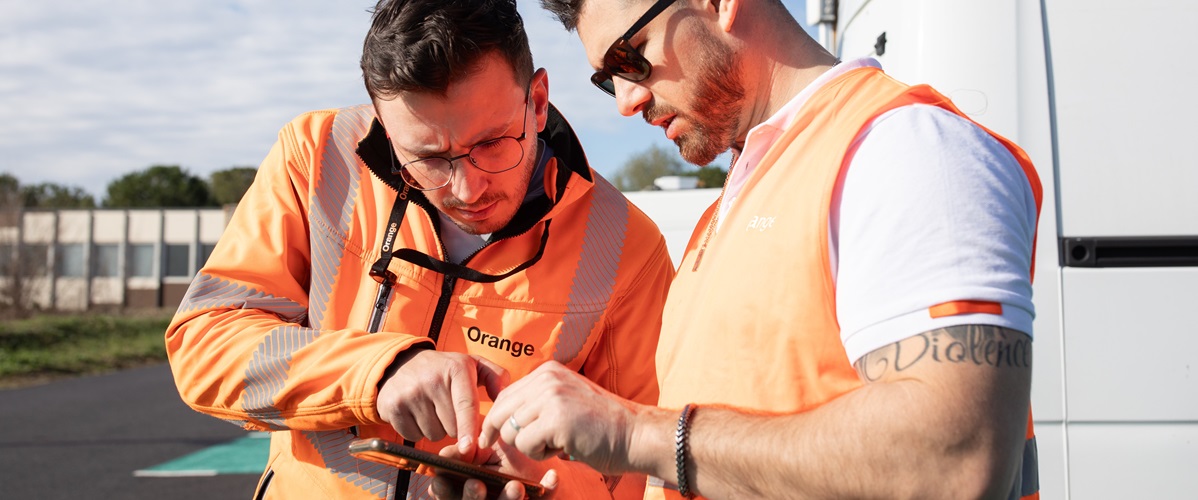
In October 2023, the research team went on six field visits, each lasting half a day to a day. The researchers were paired with an engineer specialised in the local loop, the company, the structuring network, the radio-relay link, the technical environment or end-to-end fibre. The researchers were able to observe and understand the engineers’ daily pain points.
Specifically, engineers encounter obstacles with:
- Getting their bearings in a building and finding equipment,
- Visualising the upstream and downstream network of electrical equipment,
- Getting information related to fire safety installations,
- Locating cables indoors and outdoors,
- Collaborating as a team of three during an installation,
- Comparing data without a second screen.
Definition phase
After analysing the engineers’ pain points, it became clear that augmented reality can be leveraged to address all these situations.
Observing pain points therefore made it possible to identify and prioritise PoCs already involved upstream.
The pooling of field observations made it possible to identify the key elements of the activity where targeted technological inputs can create value, and to start drawing a functional outline.
The PoCs implemented by the research teams in this stage included:
- a tracking application in a tertiary building intended for security services. This application enables a guard equipped with Microsoft’s HoloLens augmented reality glasses to be guided through a building in real time, with arrows displayed in their field of vision. Thanks to this application, the guard finds the right route, knows the actions to be carried out (closing doors, checking a fire extinguisher, for example) and can provide information about possible problems (broken glass, water leaks). At any time, the guard’s position can be visualised on the digital twin of the building to ensure their safety.
(French)
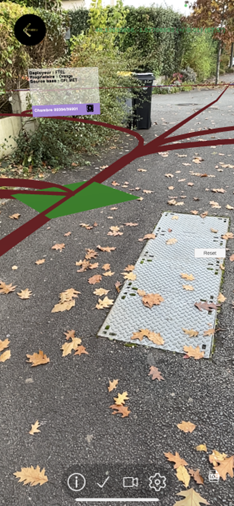
- an app to assist Orange field engineers. This app, which can be used on a phone or tablet, as well as glasses, requires additional location equipment to pinpoint the engineer’s location (with centimetre-level accuracy) during their work. To do this, Orange’s research uses an RTK (Real-Time Kinetic) antenna that replaces the phone’s GPS to provide an augmented-reality display in an engineer’s field of vision that shows the information from the information system relating to their precise location (hidden cables, details of technical equipment such as pooling points or branch points).
(subtitles available)
- an app enabling collaboration between two or three engineers located in different places.
Engineers sometimes have to work together for the same purpose (for example, re-establishing a customer’s connectivity) whilst in different locations (for example at the customer’s premises, on the street and at the central office). This app enables each engineer to download the other engineers’ environments to visualise them in their own space as avatars in their augmented-reality glasses (such as HoloLens or Apple Vision Pro). This app allows engineers to work together remotely to effectively solve the same problem.
Ideation phase
In January and February 2024, three workshops bringing together several Orange research programmes were organised with the aim of identifying use casesrelating to the “augmented engineer” in a multidisciplinary way.
This ideation phase was based on the key elements of previous steps, namely identifying the needs and motivations of field engineers and understanding their ecosystem. Building on this, Orange researchers combined, cross-checked and refined the ideas generated to meet the needs identified using Orange Research’s technological building blocks.
Decision phase
In May 2024, a workshop between several Orange research programmes helped to build a common vision of the “augmented engineer” and bring the technological building blocks and aims of the various research programmes involved into shared, coherent and achievable use cases.
Implementation phase
The foundations were laid for future simplified and optimised interventions by defining the environment and the enhanced tools for the field engineers. This implementation represents the priority use cases identified throughout this process and illustrates key technologies (including network digital twins, XR, computer vision, LLMs, brain-computer interfaces, sensing).
Experimentation phase
In 2025, a field experiment was carried out with Orange France and Marseille engineers with the aim of updating the information system using augmented reality, based on the digital twin of the fibre network.
This experiment drew on previous work on displaying data from the information system during engineers’ interventions, focusing on technical equipment. It allows the engineer to display the information from the network digital twin on their phone, overlaid on the reality filmed by the camera. In this way, if the equipment location information recorded in the twin differs from the actual location observed in real time by the engineer, the engineer can move as close as possible to the equipment’s actual location and update the digital twin in real time, with a simple click.
This experiment was carried out in Marseille with two quality engineers. It was demonstrated at Orange OpenTech 2025 (LiveField demo).
It may be extended to a more industrial version in 2026.
Conclusion
The user-centred approach applied by Orange’s research guarantees innovative tools that are tailored to the real needs of engineers in order to optimise their work.
Tests of these concrete and innovative solutions from the research are carried out with Orange’s operational teams, for increasingly effective field interventions and better customer satisfaction.
Glossary :
Network digital twin – Digital representation of a physical network to simulate, analyse and optimise its operation.
XR (eXtended Reality) – All immersive technologies combining VR (Virtual Reality), AR (Augmented Reality) and MR (Mixed Reality).
Computer vision – Field of artificial intelligence that allows machines to understand and interpret images or videos.
LLM (Large Language Model) – A natural language processing model capable of generating, understanding and translating text on a large scale.
Brain-computer interface – Technology that allows direct communication between the brain and a computer, often via sensors to detect brain activity
Sensing – The process of detecting and gathering information from sensors to perceive a system’s environment or state.